Grounded
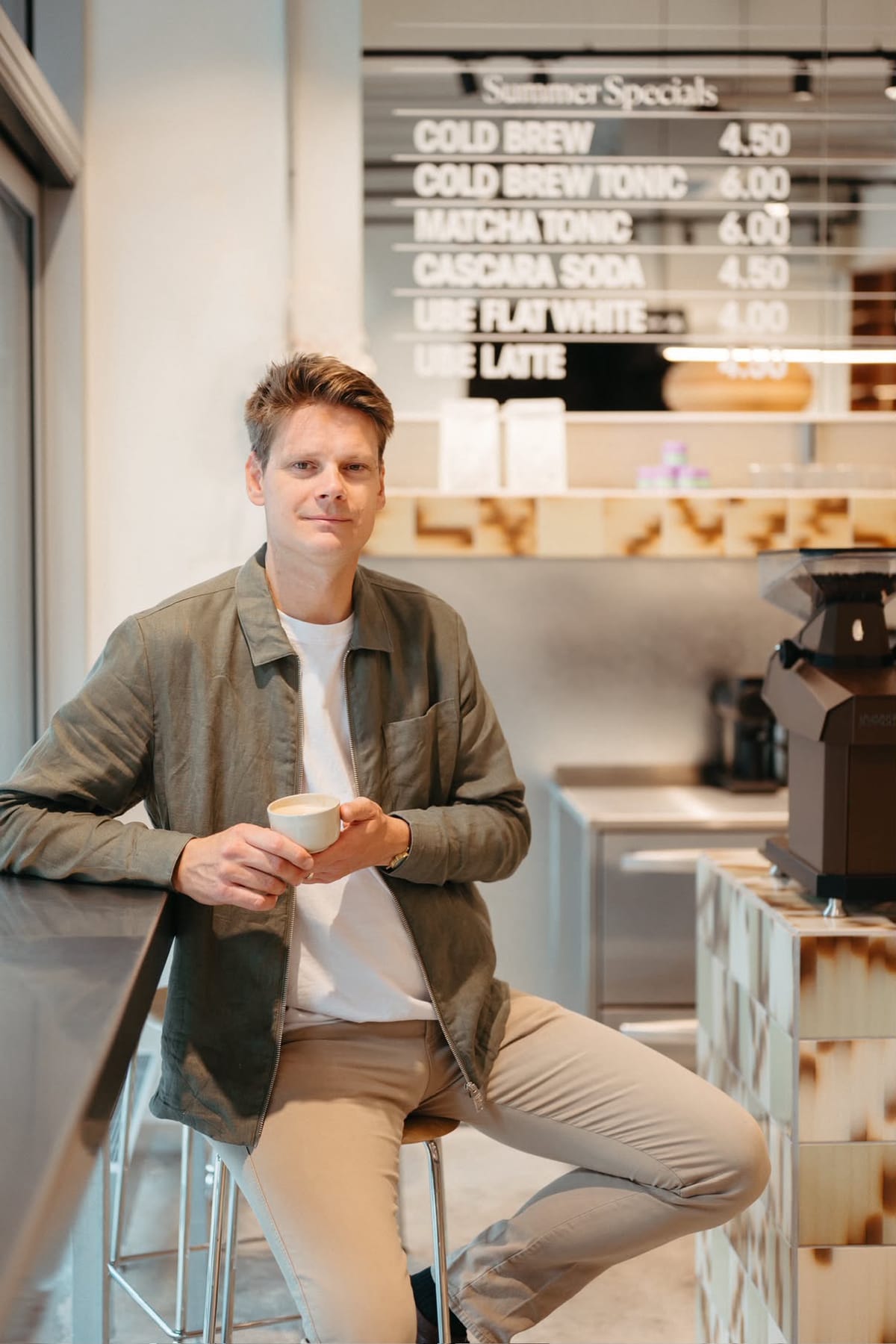
A conversation with Matthias Hoppenworth
Matthias Hoppenworth is the co-founder of Hoppenworth & Ploch, one of Germany's oldest specialty roasteries, founded in Frankfurt in 2008. Earlier this year, he spent two months in Australia and New Zealand with his family. We've met at the World of Coffee in Brussels.
Australia
You spent two months in Australia and New Zealand. I want to know what brought you there for that long — and what you actually found.
It wasn't a coffee trip. I went with my family. But of course, since I'm in the coffee industry, it was interesting for me to go there — it's kind of the motherland of the third wave. Also the U.S., but it's a movement that started by trying to replicate the Italian experience and discovering there's much more to it.
Did you feel that pioneer era when you were there?
Not really. What I felt was something different. Coffee in general — specialty coffee — is much more general there. It's not so special. It's kind of average in a very good way. Because the average coffee is really good. Everyone knows how to make coffee. It's nothing special. It's just good coffee. So you have the confidence — if you want a coffee, you just get it. You just get a good cup.
And there's a kind of — I wouldn't say it's lacking ambition. Actually, yes, I would say it's lacking ambition, but in a good way. They want to make it good, but they're not over-ambitious.
More grounded?
Yeah, grounded. That's a good word. Grown up, in a way. And when you see this high average, it's really tough to be encouraged to go to the slightly better places. Because they're already stiff, you know. And that's also the impression I have in general when I see specialty coffee concepts in Germany, in Europe. They're really stiff. I don't like to go in there.
The Specialty Bubble
That word — snobbery — comes up a lot around specialty. Is that fair?
I think we have to differentiate. Because it's easy to say snobbery, and it wouldn't do justice to the people who really care about coffee. They are really passionate. I wouldn't say people shouldn't be passionate — just the opposite.
But I know it from myself. When we made the first specialty coffee concept, we had a lot of people opposing our ideas. And then we kind of put on this mask, this facade — telling people, you don't understand it. And I know exactly where that comes from. I totally root for the people who work in specialty and feel that pushback — feel people not having patience, not really buying it.
You tell them about specialty, they come, they've heard there's good coffee here, they're excited to taste it — and then the experience in the cup doesn't match what they expected. And then they complain. You start explaining. It's a lot of work.
Where does that problem come from — expectations that are too high, or something on the café side?
I think it's both. Many people are curious — the customer and the barista, or the company that makes the coffee. They all have a different stage where they are. It doesn't mean one is superior and one is inferior. It's just different. So there's always, quite often, a mismatch.
And I think coffee is the hardest thing to tackle. If we think about food — we all agree, this is great food, this is average. If we have a great burger, we agree. It's much easier to have a consensus. Coffee is so diverse. There's a huge variety of what good coffee tastes like — because coffee is always good when people say it's good coffee.
So when someone has the expectation of a really bold, chewy, creamy, dark-roasted espresso with low acidity, and you give them specialty coffee — people will be really disappointed. It's bad coffee for them. But many, many people don't like this profile. And of course they are wrong, but they are right, because they have the buying power. The problem isn't the coffee. It's the mismatch between what someone expected and what landed in the cup.
Understanding the Guest
Sometimes I feel like there's a small space between what people order and what they're actually looking for. If we understand that space, we can make someone feel welcome without explaining a single thing about coffee.
Exactly. And what specialty cafés often fail to do in that moment is have empathy for the customer. To ask them: what are you used to drinking? Do you want to have an experience, or do you want me to serve something you know and love?
It's never the customer's fault. Never. Because the customer pays the bill. But I would say — let's not talk about faults. I think there are opportunities. New ideas about how to market specialty coffee, how to sell it. And it all has to do with empathy. Understanding the people who come in. Just ask questions. Did you like it? How can I make it better? I have some information for you — would you like to hear it? No? It's okay.
As a barista, you have to feel the room. There should be some air between you and the customer — a space where you can quickly understand: does this person need to know what anaerobic and washed mean — or do they just want ein Kaffee, bitte?
That order — ein Kaffee, bitte — is probably the most common thing a barista hears.
It's one of the toughest ones to nail because it gives me so many signals.
I was in Heidelberg at Coffee Nerd — where I met you. Thomas Mohr made the place, and it totally breathes specialty coffee — a great selection of high-end coffees from different roasters. The stage is clear. So it's quite normal for people who seek specialty coffee to go in. Your concept is really clear-cut.
But now, when I'm also more in the ultra part of the spectrum, and we have different people coming to us — also just lots of simple people who come in and say, eine Tasse Kaffee, bitte — it's an interesting exercise. This small signal gives you so much to work with. You have to give more attention to it, and less at the same time. Just give the person what they want. A good cup of coffee. And here, you can make someone's day better, easily, without starting the whole lecture. But not always. It's always a matter of taste. If I go to a butcher, I don't say "give me meat." I say what I want. But coffee doesn't work that way yet.
So this small moment — this is where you can either make it all for nothing, or you can make it better without a lecture.
Comfort vs Curiosity
You said that lecturing doesn't work. That's a strong position.
We tried the lecturing thing ourselves. And it exhausted us, and it exhausted the customer. The concepts that succeed are always the ones that don't lecture. You just get a fine cup of coffee. There will be enough people who are curious and ask questions. But most people don't care.
And you earn much more money if you don't ask the questions. If you're just friendly, if you have a good workflow, if you serve coffee fast and it's well made, you can have success. You can scale the business.
People don't want to feel stupid. They go to a place — un caffè, espresso — they want to be Italian. They want to be seen. They want to feel great.
And then you say, sorry, we only have light roast. Like you're better or something. I feel it myself sometimes — this moment where my own enthusiasm becomes a wall between me and the guest. It's not intentional. But it's there.
It's a question of trust.
Between a barista and a guest, there is this moment of truth — either I trust you or not. And you can build that trust from nothing, even with the people who came in expecting something completely different. You just have to feel this moment, feel the customer, feel the person. Create the atmosphere.
But all this is only true if you have ambition in coffee. Then you have this conflict — I want to show my craft, I want to show these coffees. You will attract a certain niche, for sure. But how many?
In Coffee Nerd — one of the most intentional specialty places I know — maybe 10 to 15 percent of customers actually engage with what's in the cup.
Yeah. But even in a place like Coffee Nerd — the people paying, you know it better than me — it's cappuccino, flat white. People who are coming in and saying, I want filter, or I want espresso, washed, natural — small percentage.
Although you position yourself as really doing specialty, it's still a small percentage who really care. And if you think about how many people would be put off if you started lecturing them — I think that number is high. Really high. That's why I'm a bit tired of having a specialty place.
I'm also seeing a real demand for something more appealing. I'm thinking of this welcoming place — everything focused on aesthetics, but... Old-fashioned, ambitious, but not nerdy. You know this kind of place.
Stylish.
Yes. It's something that's always lacking. These places that just make good coffee. It's so easy to make great coffee that way.
Espresso Is Still the Hardest Drink
When we started back in 2008, we served what today would be considered a very traditional espresso. Really dark roasts, sometimes even with 40% Robusta. We focused on making the milk right; we were among the first to pour latte art, and people came just for our espresso.
Today it's almost the opposite. Maybe only 10% of customers actually enjoy espresso. Most people prefer milk drinks. Milk is comforting. Espresso isn't. If it's even slightly off, it's sour, bitter or simply uncomfortable.
I agree. Espresso is probably one of the hardest drinks in coffee. Filter coffee is much more forgiving.
Maybe that's also why soup shots are becoming more popular. Perhaps the traditional espresso recipe has such a tiny window where everything comes together perfectly. Soup shots simply make that space bigger — easier for the barista to brew well and easier for the customer to enjoy.
I know what you mean, but I never found pleasure in them. I'm really old school. I still like body shots. Highly concentrated espresso with texture and weight.
I recently bought a coffee in Hamburg. I asked the roaster: "What's your roast style?"
"Medium."
I bought it. It was just ashes.
And if you go to the roastery I worked with until recently, their "medium" would be undrinkably sour for many people. So nowadays I honestly don't know what medium roast even means anymore. If someone tells me it's medium, I immediately think it's dark.
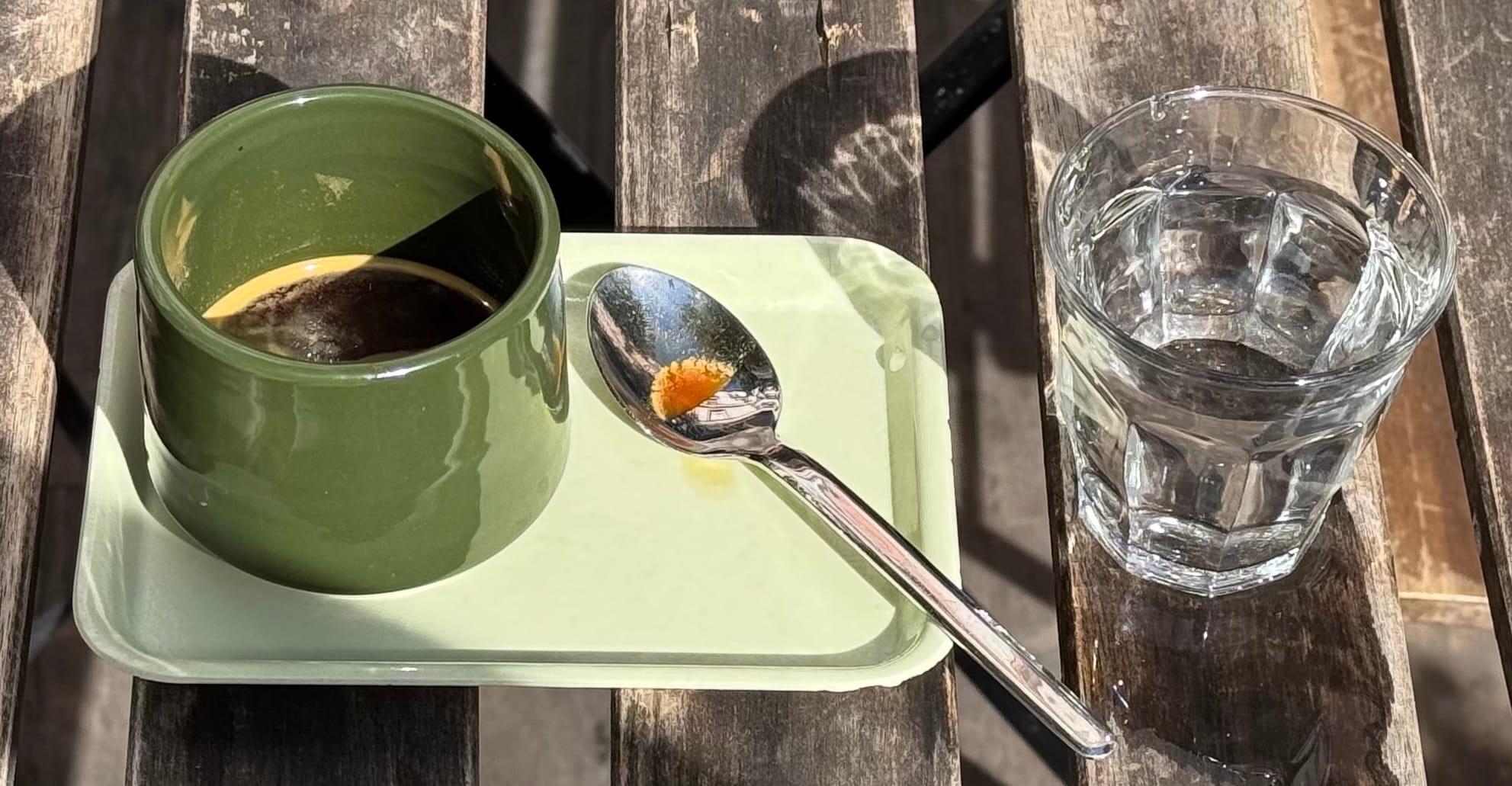
That's exactly what fascinates me about espresso today. Five years ago, everything seemed much simpler. We all learned the same recipe: 1:2, around 25 seconds, nine bars, 93°C. Today almost everything can be different and still taste great.
At Coffee Nerd we often brew very light roasts as espresso, using lower temperatures, lower pressure and much faster extractions — sometimes only 10 to 14 seconds. Five years ago that would've sounded completely wrong. Today it produces some of the sweetest and most expressive espressos I've ever tasted.
I still believe in the classic recipe. Not because it's the only correct one, but because beginners need a reference point. Learning to consistently brew a balanced 1:2 espresso is already difficult. Once you understand those foundations, then you can start breaking the rules.
It reminds me of music.
For a long time, there was only one "genre" of espresso — just like there was once only classical music. Everyone was trying to reach the same sweet spot, refining the same formula. Now it feels as if we've discovered there isn't just one sweet spot anymore. There are different sweet spots, different dimensions of flavour.
It's like music evolved from classical to jazz, blues, hip-hop, soul or R&B. We still have the same seven notes, but people create completely different kinds of music with them. Coffee feels the same. We still use the same coffee, grinders and espresso machines, but we're discovering completely different ways of making something delicious.
I like that comparison. There used to be just one kind of music, and now it's much more diverse.
But at the end of the day, most people still like pop music.
And most people will probably keep drinking milk drinks. And they'll happily pay $4.60 for one.
Yeah, that's the way it goes.
Automation Isn't the Enemy
Back to Australia — what did the café model look like in practice?
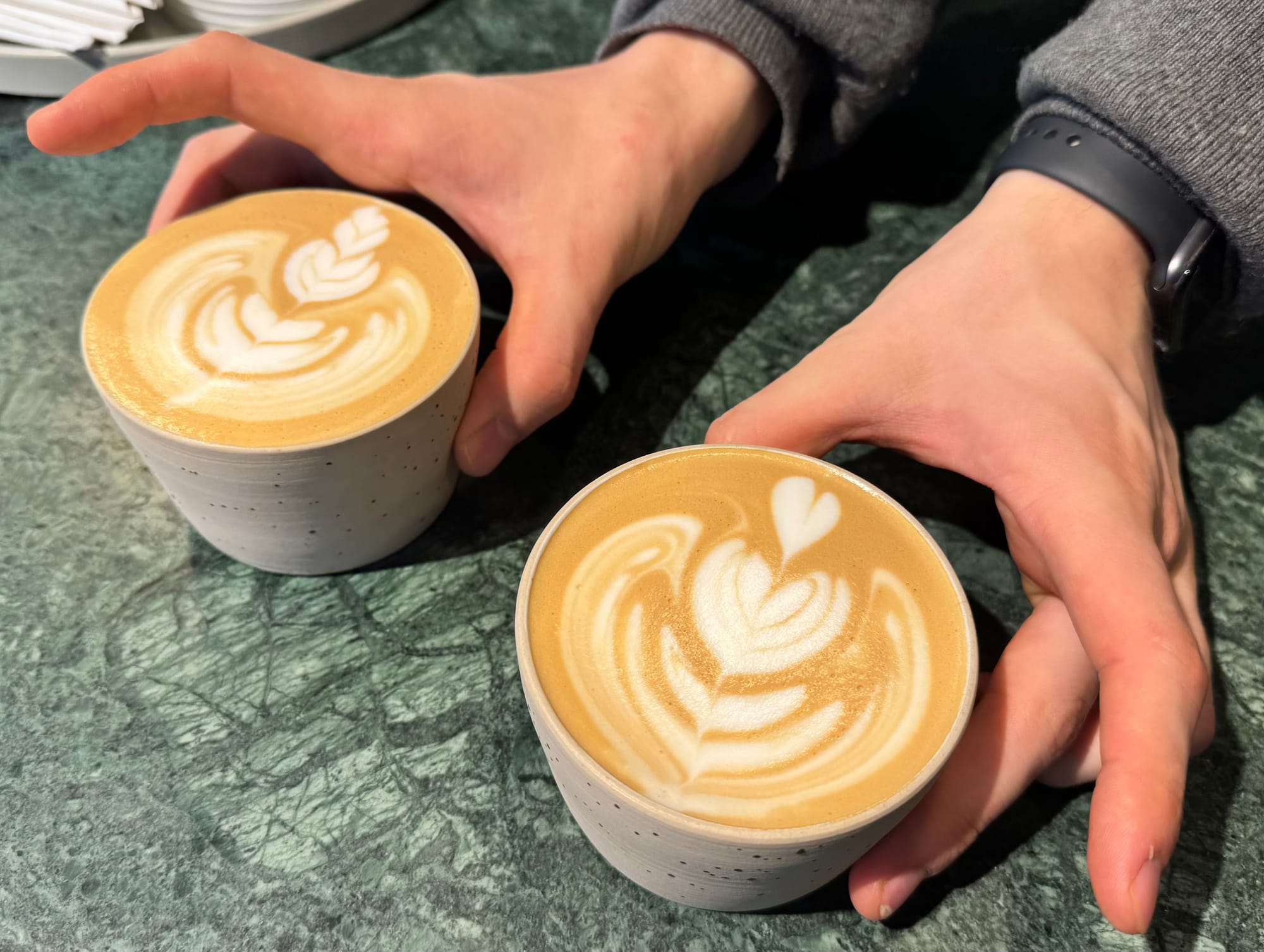
Flat whites. That was the go-to. And coffee in general was really average — I mean that in a good way. It's just there. Many cafés use automated milk foaming systems. Everyone knows how to steam milk. And many places only do takeaway. I was a bit disappointed by the amount of paper cups. No sustainable packaging. Just single-use, everywhere.
What struck me was the workflow. They pour the espresso into the paper cup, then pour milk directly from the foaming system. No pitcher. No latte art. Espresso, milk, done. It's super lazy, but it's super fast. And it makes sense — these systems can steam more consistently than humans.
From what a barista who worked there told me — it's a completely different industry. Shifts start at six, sometimes seven in the morning, closing at one or two. Constant rush, everyone ordering at once.
Yes. And the labour costs are higher there. So there's more pressure to automate, to be faster. But the business model is clean — coffee is a morning thing. You open, you serve, you close. Easy products, well made. As an entrepreneur, I thought, that's actually smart. You don't have to be open all day.
What about the relationship between roasteries and cafés?
That was the most interesting thing. I talked to a café owner in Sydney working with Campus. He said he pays a relatively high price per kilo — but he gets an espresso machine, cups and training for new staff. If he has a new barista, he doesn't have to train them himself. He sends them to the roastery. They have a lab; they provide the basics — how to make espresso, how to steam milk. The roastery is selling not just coffee but the whole solution. The café gets branded, supported, and trained.
In Sofia, almost every place—a bakery, a small café, just ordinary places—served some sort of specialty coffee. Medium roasted, nothing crazy. Local roasters supplied them with coffee and, I guess, also the knowledge to run it properly. You could walk into almost any place and expect an average good coffee.
Yes. Making specialty coffee average. If you can target small owner-run places — bakeries, neighbourhood spots — and say: I know your pain points; I'll solve them for you. You don't have to deal with the complexity. Here's a fully automatic machine. Here's training. Here's branding.
I believe in fully automatics. I think it's a huge opportunity. Specialty coffee can be automated. Focus on experience, or just be fast.
There's a pre-batching conversation happening in Australia too — Axil Coffee; I heard a podcast; they are pre-batching. They're really - I wouldn't say aggressive; they are really confident. They are confident in making pre-batch coffee. So they prepare the coffee; they have a dispensing system; they're really pretty, and they say none of the people taste the difference between the pre-batch coffee and the freshly made coffee, but you are extremely fast. So you can move faster, or you can sell cheaper. Without quality issues.
Now, working with a fully automatic machine, I don't see the downsides. Think about consistency. During a rush, shot after shot, the temperature is rising, and you can be more than sure that 95% of shots are tasty and drinkable. You're making things quick and efficient. With pre-batched espresso, that's all even more predictable.
If the customer gets the best product, if I, as a worker, get a nice workflow, if the owner makes money — all three groups of people are happy. There's no problem. There's just an advantage.
The Future of Coffee Shops
What's not working in the current specialty business model?
The business model in specialty coffee isn't working great. It has never worked great, and it's going to work less and less. Low revenue, a lot of hard work per cup. If you have a food concept — a burger — you make 20 euros per customer. In coffee, you make five. You need much higher volume.
And labour costs are only going up. In Germany, the minimum wage is rising. The mini-job model is being phased out. That's been one of the main drivers of affordable staffing in hospitality. So you have to get creative in substituting labour. You have to find food items you can calculate well. You have to focus.
I've been talking to people from various bakery concepts. The business case is strong when you attach a bakery to a coffee concept. Frozen croissants, local pastries — it's efficient. But the concept still needs sharpness. A real edge.
Is matcha part of this conversation?
Matcha is here to stay. It's coming to the masses; it'll become more affordable. In ten years, people will still be drinking matcha. I was in Japan ten years ago and imported our own matcha back then — we were selling it before anyone talked about it here. And now it's everywhere. That's how it goes.
You can find a niche in matcha too, because nobody is talking about the farmer yet. The same conversation specialty coffee had — where does this come from, who grew it — that hasn't happened in matcha. Someone will do it.
Australia as an Example
What would you take from Australia back to Europe?
Being more average. In a good way. The confidence that good coffee is just normal. Not special. Not a performance. And the roastery-as-service model — that's worth importing. The idea that a roastery's job isn't just to roast coffee, but to support the places serving it. To solve problems rather than just supply beans.
Matthias Hoppenworth recently left Hoppenworth & Ploch and is currently working independently.
There is more to come.
If you enjoyed this story, consider subscribing to The Human Brew. I’ll see you in the next one.